Loading
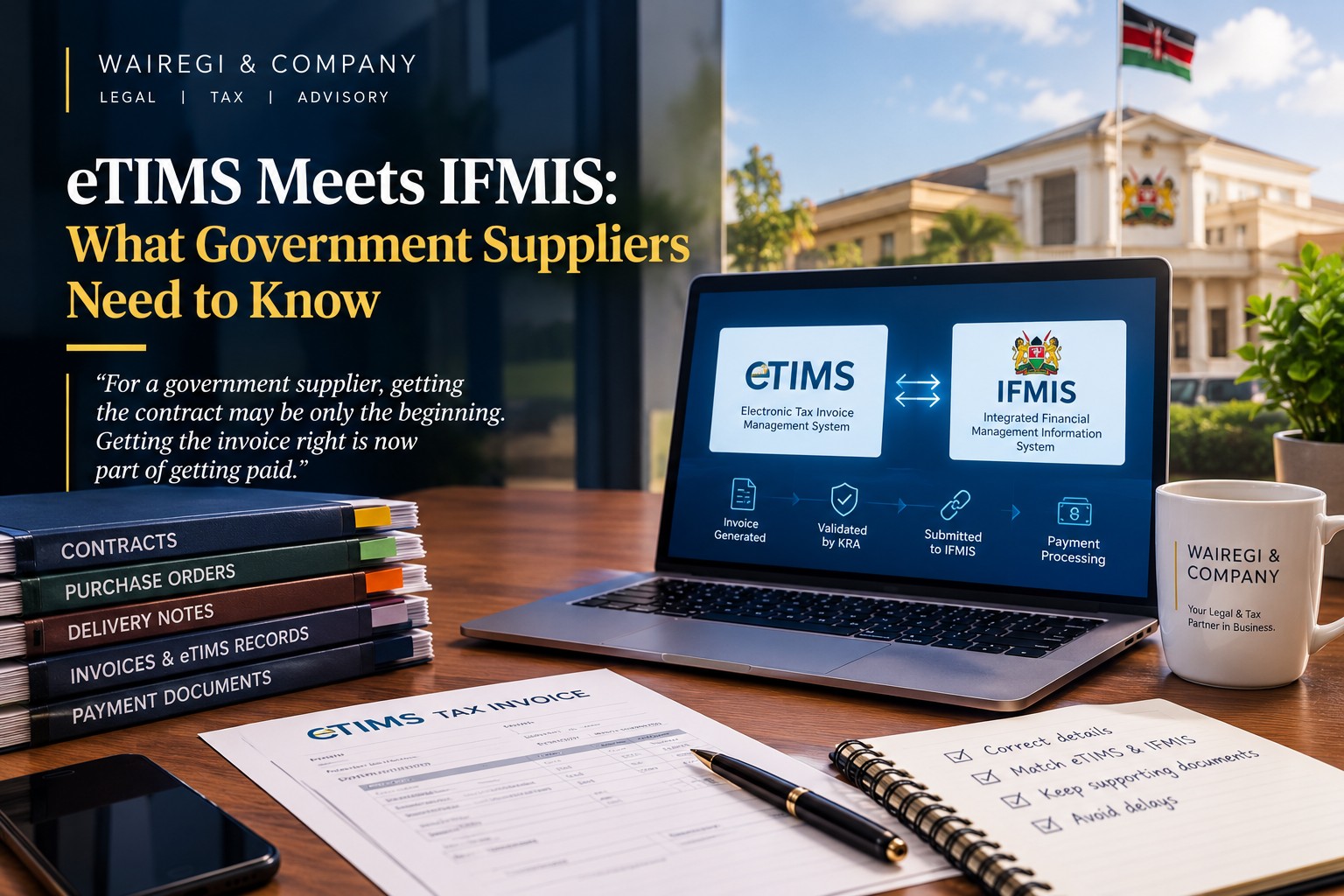
“For a government supplier, getting the contract may be only the beginning. Getting the invoice right is now part of getting paid.”
For businesses that supply goods and services to Government, invoicing is entering a new phase.
In August 2026, the Kenya Revenue Authority (KRA), together with the National Treasury, announced the implementation of the integration between the Electronic Tax Invoice Management System (eTIMS) and the Integrated Financial Management Information System (IFMIS).
The objective is straightforward: to connect tax invoicing with Government's payment processes and make it easier to verify invoices before payment. KRA has directed that suppliers generate a valid eTIMS invoice before submitting it through IFMIS, with the information in both systems required to correspond.
For suppliers, this creates a simple but important question:
Does your invoice tell the same story in both systems?
One transaction, one story.
A government supply can generate several records: a contract, purchase order, delivery documentation, eTIMS invoice and IFMIS payment request.
Previously, these records could exist in different administrative processes. With the integration, they are becoming increasingly connected.
That means details such as the supplier's PIN, invoice number, description, quantities, amounts and applicable taxes need to be accurate and consistent.
A discrepancy does not automatically mean that a taxpayer has done something wrong. Errors, corrections and legitimate changes can occur. But businesses will need to be able to identify and explain them.
The safest approach is therefore to ensure that the information is correct before the invoice enters the payment process.
Why this matters to suppliers.
For a supplier, particularly a small or medium-sized business, delayed payment can quickly become a cash-flow problem.
A completed contract does not necessarily mean immediate access to the money owed. If an invoice requires additional verification because the information submitted through IFMIS does not correspond with the eTIMS record, an otherwise legitimate payment may face an administrative hurdle.
This makes tax compliance part of financial management.
The finance team should not be the only people concerned. Staff handling procurement documents, contracts, deliveries and Government accounts should understand how their records eventually feed into the invoicing and payment process.
What should suppliers do?
A simple pre-submission check can prevent many avoidable problems.
Before submitting an invoice through IFMIS, a supplier should confirm that it corresponds with the eTIMS invoice and the underlying transaction.
The business should particularly check the:
· supplier's tax details;
· invoice number and date;
· description of goods or services;
· quantities and amounts; and
· applicable taxes.
Supporting documents should also be properly retained. Contracts, purchase orders, delivery notes, certificates of completion and payment records may become important if questions later arise about the transaction.
The objective is not simply to satisfy a system. It is to ensure that the entire transaction can be explained from beginning to end.
A wider shift in tax compliance.
The eTIMS–IFMIS integration reflects a broader development in Kenya's digital tax administration: information generated in one system can increasingly be compared with information generated elsewhere.
For businesses, that means the days of treating tax records, accounting records and commercial documents as separate worlds are gradually disappearing.
Government suppliers should therefore begin viewing the transaction as one connected chain:
Contract → Supply → eTIMS Invoice → IFMIS Submission → Payment.
Each stage should support the next.
Before you submit that invoice.
The message for Government suppliers is simple.
Do not wait until an invoice is rejected, queried or delayed before checking whether your records align.
Review your invoicing procedures. Train the staff responsible for Government transactions. Reconcile your eTIMS records with your accounting system. Keep the underlying documentation.
Because in the new digital government payment environment, an invoice does more than request payment.
It must also tell the same story wherever it appears.