Loading
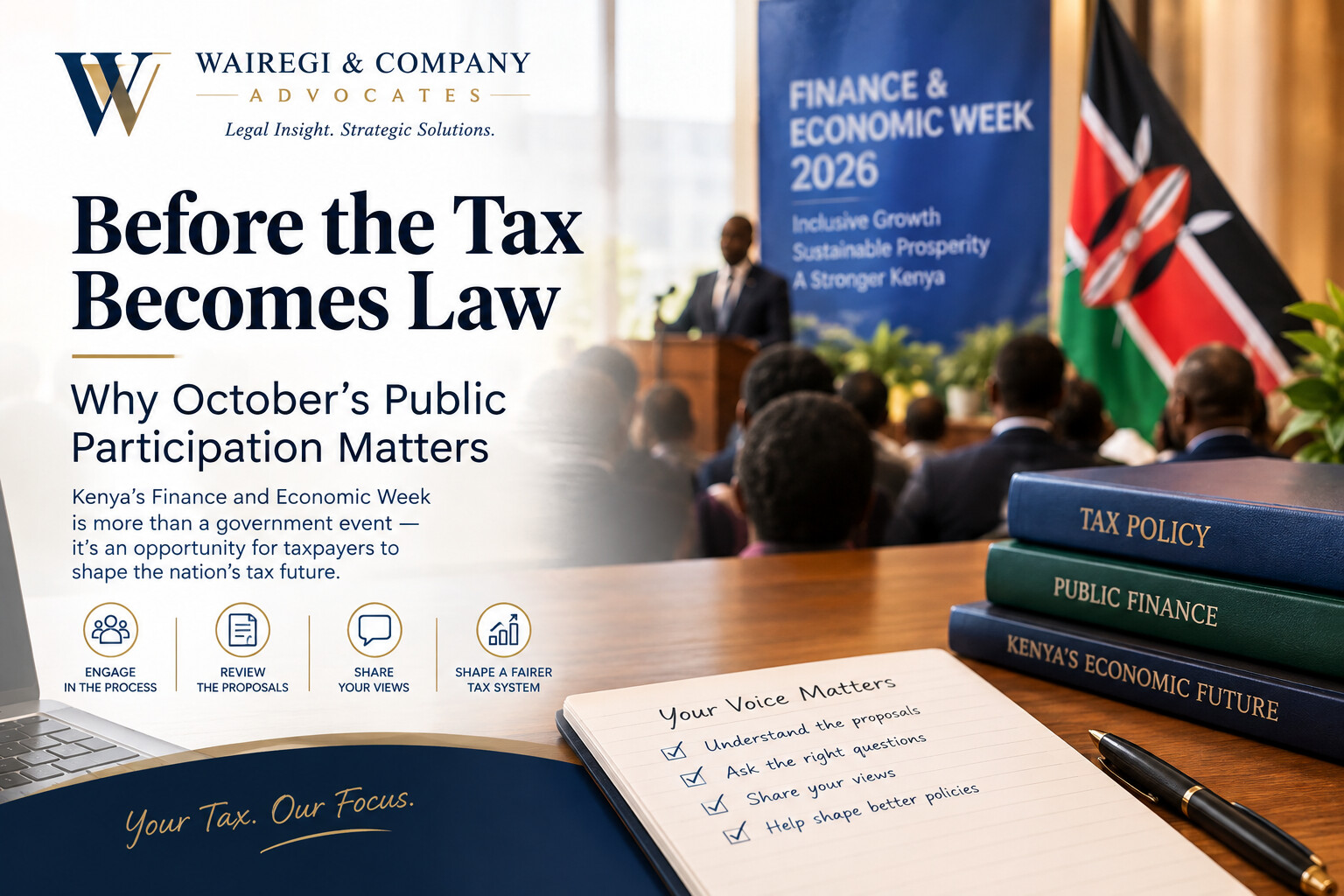
For many Kenyans, tax policy becomes real on one familiar date: payday.
A deduction appears on a payslip, a business receives a tax assessment, or a new compliance requirement appears on the horizon. Yet long before a tax measure reaches a payslip or a tax return, there is another stage at which taxpayers can have their say: the policy-making process.
October 2026 is set to provide precisely such an opportunity.
The National Treasury has announced a seven-day Thematic Week on Economy (Finance), running from 12 to 18 October 2026 as part of the Mashujaa Day 2026 celebrations. Planned discussions and public-engagement activities are expected to cover revenue mobilization and taxation reforms, public finance and debt management, savings and investment, private-capital mobilization, pensions and financial inclusion. The discussions come at a particularly important time as Treasury prepares to undertake public participation on proposed changes to the Pay As You Earn (PAYE) framework.
For taxpayers, therefore, October should not simply be marked on the calendar as another government event. It should be viewed as an opportunity to understand what is being proposed, why it is being proposed and what it could mean for individuals, employers and businesses.
PAYE: A proposal, not yet a promise on the payslip.
Among the proposals attracting public attention is a proposed revision of the PAYE structure.
The government has indicated proposals that would exempt employees earning up to KSh 30,000 per month from PAYE, while reducing the rate applicable to income between KSh 30,000 and KSh 50,000 to 25 per cent. Treasury has indicated that public participation will precede the introduction of the proposed legislation to Parliament.
But there is an important legal distinction that taxpayers should keep in mind: a proposal is not the law.
The proposed changes were not included in the enacted Finance Act 2026. Consequently, the current PAYE framework remains applicable unless and until Parliament considers and passes legislation changing it. The October consultations are therefore part of a process—not the conclusion of one.
This distinction is particularly important for employers. Payroll systems should not be altered merely because a tax proposal has been announced. Businesses should instead monitor the legislative process and the eventual wording of any enacted amendments.
Public participation is more than attending a meeting.
Kenya's Constitution places public participation at the heart of public financial management.
Article 201(a) requires openness and accountability in public finance, including public participation in financial matters. Article 232(1)(d) further recognises the involvement of the people in the process of policy-making. Section 35(2) of the Public Finance Management Act also provides for public participation in the budget process. The National Treasury expressly identifies these provisions as part of the legal framework governing public participation in financial matters.
The significance of these provisions is straightforward: taxpayers are not merely recipients of tax policy; they are participants in the process through which public financial decisions are developed.
But meaningful participation requires more than sitting in a hall, listening to presentations and leaving.
A taxpayer who wants to participate meaningfully should first understand the proposal, identify the provision or policy issue of concern, consider its practical consequences and, where appropriate, present a clear and evidence-based submission.
For businesses, this may involve examining the effect of a proposed tax measure on employment costs, cash flow, investment decisions or compliance obligations. For employees, it may involve considering the effect of proposed PAYE changes on disposable income. For professional and industry bodies, it may mean presenting evidence on whether a proposed measure is administratively workable and economically sustainable.
The questions taxpayers should be asking.
The most valuable contribution to public participation is not necessarily the loudest one. It is the one that asks the right questions.
· What will a proposed tax change mean for different categories of taxpayers?
· Will the measure be simple to administer?
· Will it create unintended compliance burdens?
· How will the proposed changes affect employers and payroll administration?
· If revenue is reduced in one area, what are the implications for public revenue and expenditure?
· Are the proposed provisions sufficiently clear to give taxpayers certainty about their obligations?
These questions move the conversation beyond whether a taxpayer simply likes or dislikes a proposed tax measure. They invite consideration of legality, fairness, administration, and economic impact.
That is where informed public participation becomes particularly valuable.
Read. Assess. Participate.
As the thematic week starts, taxpayers and businesses should consider a simple strategy:
Read. Go beyond headlines and social-media discussions. Read the actual proposals and accompanying explanatory material when published.
Assess. Consider how the proposals could affect your income, business, employees or compliance obligations. Where possible, use figures and evidence to understand the practical consequences.
Participate. Make submissions through the appropriate channels. Identify the specific issue, explain your position clearly and, where possible, propose a workable alternative.
This approach turns public participation from a constitutional formality into a meaningful contribution to Kenya's fiscal policy.
The bigger picture.
The October discussions are ultimately about more than PAYE.
They form part of a broader conversation about how Kenya raises revenue, manages public resources and balances the competing demands of economic growth, public services and taxpayer obligations.
A strong tax system requires more than effective revenue collection. It also requires clarity, predictability, accountability and public confidence.
The public participation process provides an opportunity to strengthen that conversation.
For taxpayers, the message is therefore simple: do not wait until a tax measure appears on your payslip or becomes a compliance obligation before taking an interest in it.
The conversation starts earlier.
Your tax matters. Your voice matters. And October provides an opportunity to use both.
Wairegi & Company Advocates remains committed to providing timely legal and tax insights on developments affecting Kenyan taxpayers and businesses.