Loading
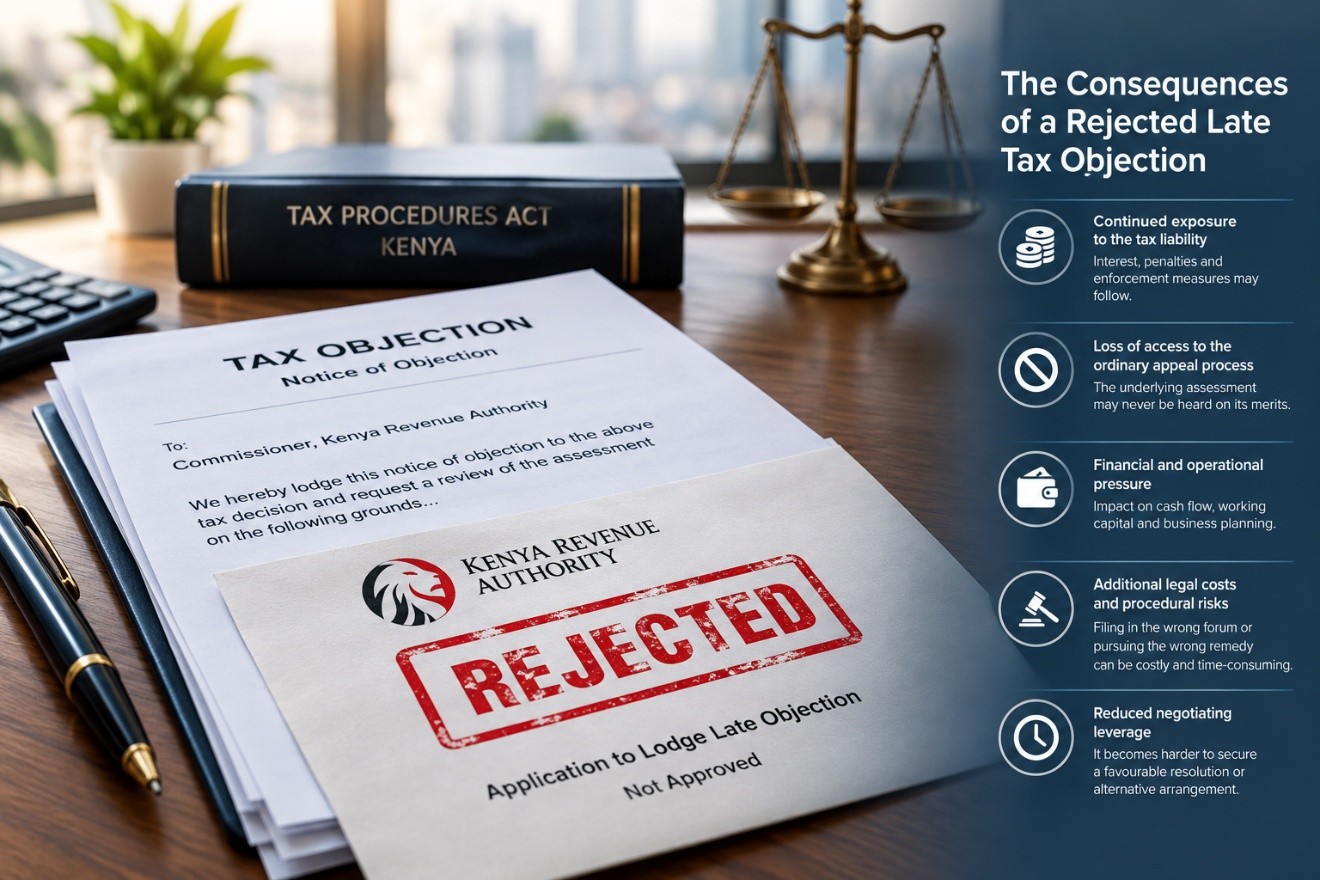
“Why missing the objection deadline can leave taxpayers facing substantial liabilities without access to the ordinary route for challenging an assessment.”
A tax assessment is not necessarily the end of a dispute between a taxpayer and the Kenya Revenue Authority (KRA). Kenyan tax law provides a formal mechanism through which a taxpayer may challenge a tax decision believed to be incorrect. However, that right must be exercised within the prescribed statutory framework. Where a taxpayer misses the deadline and KRA rejects an application to lodge an objection out of time, the consequences can extend beyond a procedural inconvenience to affect the taxpayer’s finances, business operations and ability to obtain substantive review of the assessment.
Understanding these consequences begins with understanding the nature of a tax objection and the legal significance of the deadline.
What is a tax objection?
A tax objection is a formal written challenge lodged by a taxpayer who disputes a tax decision made by KRA. It provides the taxpayer with an opportunity to explain why the decision should be reconsidered, identify errors in the assessment and present evidence supporting the proposed correction.
Under section 51 of the Tax Procedures Act, 2015, a taxpayer wishing to dispute a tax decision must ordinarily lodge a notice of objection with the Commissioner within 30 days of being notified of that decision. The objection must specify the grounds of disagreement, the amendments sought and the reasons supporting those amendments. Relevant documents must also be submitted, while the statutory requirements concerning payment of undisputed tax must be addressed.
The objection process is important because it provides the initial statutory route through which a tax dispute is examined before a taxpayer proceeds to the next stage of appeal. It is not enough to informally disagree with KRA or to maintain that an assessment is inaccurate. The taxpayer must communicate the dispute in the prescribed manner and within the applicable timelines.
But what happens when the taxpayer fails to act within those 30 days?
When the objection deadline is missed.
The law recognises that circumstances may prevent a taxpayer from lodging an objection within the prescribed period. Section 51 therefore permits a taxpayer to apply in writing for an extension of time. The Commissioner may allow the application where the taxpayer demonstrates that the delay resulted from absence from Kenya, sickness or another reasonable cause, and that the taxpayer did not unreasonably delay lodging the objection.
An extension, however, is not automatic. The taxpayer must provide a credible explanation supported by appropriate evidence where available. A lengthy period of inaction, an unexplained failure to monitor correspondence or a general assertion of financial or administrative difficulties may leave the taxpayer unable to establish the statutory grounds.
Where the application is rejected, the taxpayer faces a critical procedural difficulty: the ordinary objection process may not proceed to an examination of the underlying assessment. The rejection does not necessarily establish that KRA calculated the tax correctly. It means that the taxpayer may be unable to challenge that assessment through the ordinary objection-and-appeal route unless an appropriate further remedy is available.
This distinction is fundamental. A taxpayer may have a genuine dispute about the amount assessed, but the existence of that dispute does not dispense with the statutory requirements governing access to the appeal process.
The financial consequences of rejection.
The immediate concern for many taxpayers is the continued exposure to the disputed tax liability. Where the objection process has not been validly activated, the assessment may remain operative, leaving the taxpayer exposed to payment demands and, where legally applicable, interest, penalties and recovery measures.
For businesses, the consequences can be particularly serious. A substantial assessment can place pressure on working capital, interfere with supplier payments and affect the ability to meet payroll or finance ongoing operations. Funds that would otherwise support expansion, inventory purchases or investment may have to be redirected towards addressing the tax exposure.
The uncertainty can also affect business planning. A company that cannot obtain a determination of its tax dispute through the ordinary process may struggle to forecast its tax position accurately or make informed decisions about its available resources. The impact is not limited to the amount demanded by KRA; it may extend to the wider financial decisions that depend on certainty about the business's liabilities.
For individual taxpayers, the consequences may similarly affect household finances, savings and other financial commitments. The precise exposure depends on the assessment, the applicable tax legislation and any available relief or remedy.
The loss of an opportunity to challenge the assessment on its merits
Perhaps the most significant consequence is the possibility that the substantive dispute will never be examined through the ordinary appellate process.
Consider a business that disputes an additional assessment because it believes that KRA overlooked invoices, misclassified transactions or disallowed legitimate expenses. If its application to object late is rejected, the business may be unable to proceed directly to the Tax Appeals Tribunal on the merits of the assessment.
This creates a distinction between having a potentially valid argument and having access to the statutory process through which that argument can be determined. The strength of the taxpayer's evidence does not, by itself, cure failure to comply with the procedural requirements.
The implications are illustrated by decisions including Robert Chukunwe Makokha v Kenya Revenue Authority and Muscom Limited v Kenya Revenue Authority. These decisions are useful examples of the jurisdictional difficulties that may arise when a taxpayer seeks to challenge a rejection of a late-objection application through the ordinary Tribunal appeal process.
Their broader significance is that a taxpayer must identify the correct legal remedy for the particular decision being challenged. A rejection of an application for an extension of time is not necessarily equivalent to an objection decision on the substantive tax dispute. Where the Commissioner has refused permission to object late, judicial review may be relevant if there are proper grounds to challenge the lawfulness of that refusal. However, judicial review is not simply a substitute for a substantive tax appeal, and its availability depends on the circumstances and applicable law.
The additional cost of procedural mistakes
A rejected late objection may also generate further legal expenses. A taxpayer who proceeds to the wrong forum risks having the proceedings struck out for want of jurisdiction before the substantive dispute is considered. The taxpayer may then incur additional professional fees and lose valuable time while the underlying tax exposure remains unresolved.
There is also the risk of allowing further deadlines to expire while pursuing an unsuitable remedy. The result can be a more complicated dispute, with fewer practical options available than would have existed had the original objection been lodged on time.
This is why the response to rejection must be carefully considered. Taxpayers should examine the written decision, establish the legal basis for the rejection and obtain advice on the appropriate remedy promptly. They should not assume that an application for judicial review automatically suspends payment obligations or enforcement action.
Preventing the problem before it arises.
The consequences of rejection underline the importance of effective tax administration within businesses. Taxpayers should maintain accurate accounting records, monitor KRA correspondence and promptly review assessments when they are issued. Responsibility for tax notices should be clearly assigned, and objection deadlines should be recorded and monitored.
Where an assessment is disputed, the taxpayer should prepare a reasoned objection supported by the relevant documents and identify precisely the corrections sought. If the deadline has already passed, the application for an extension should explain the circumstances that prevented timely filing and address the statutory conditions for granting additional time.
Professional assistance can be particularly valuable where the assessment is substantial, the underlying transactions are complex or the taxpayer is uncertain about the correct procedural route.
Conclusion: A missed deadline can carry a substantial price.
The rejection of an application to lodge a late tax objection demonstrates that tax disputes are governed by both substantive tax law and procedural discipline. The taxpayer may believe that an assessment is incorrect, but the ability to challenge it through the ordinary appellate process depends on compliance with the applicable statutory requirements.
For taxpayers, the consequences may include continued exposure to a disputed liability, financial pressure, additional litigation costs and difficulty obtaining a substantive determination of the assessment. Rejection does not, by itself, establish that the assessment is correct or that every possible legal remedy is unavailable. It does, however, create a serious procedural obstacle that must be addressed through the appropriate legal channels.
The lesson for businesses and individuals is clear: a tax objection is not merely a disagreement with KRA; it is a statutory process that must be activated correctly and within time. Prompt action can preserve the opportunity to challenge an assessment, while delay can turn a potentially contestable tax dispute into a much more difficult and costly legal problem.