Loading
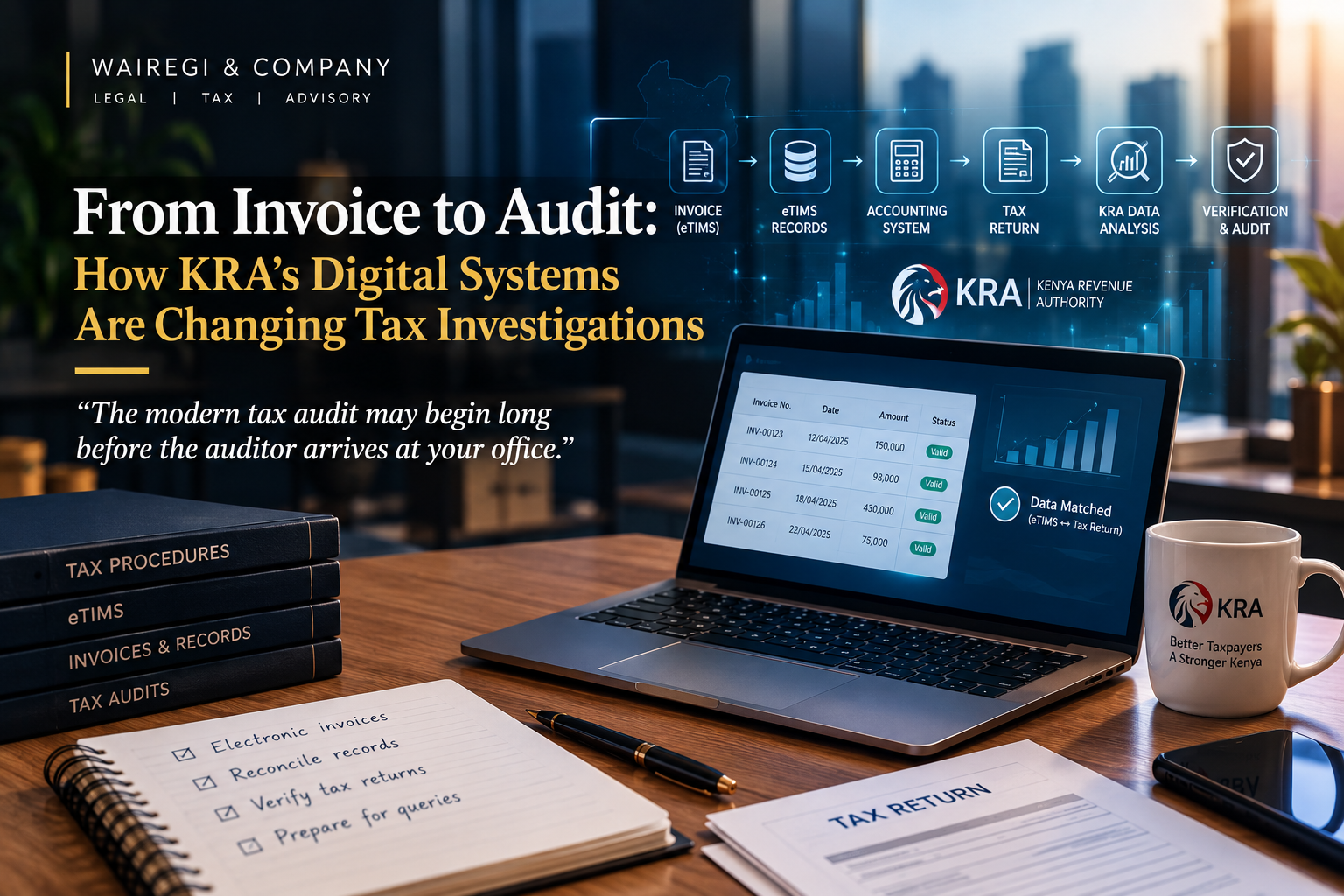
“The modern tax audit may begin long before the auditor arrives at your office.”
A tax audit traditionally brought to mind a familiar scene: a KRA officer requesting invoices, ledgers, bank statements and other financial records, followed by a lengthy exchange between the taxpayer and the Authority.
That picture is changing.
Kenya's tax administration is becoming increasingly digital, and the information generated by ordinary business transactions is becoming an important part of the compliance process. An invoice issued today can become part of a much larger trail of information that may eventually be used to verify what a business declares in its tax returns.
The journey from invoice to audit is therefore becoming shorter and more connected.
It starts with the invoice.
For businesses, the first step is often an ordinary commercial transaction.
A customer purchases goods or services. An invoice is issued. The transaction is recorded in the accounting system and payment is eventually made.
Under eTIMS, however, the electronic invoice is more than a document exchanged between buyer and seller. It forms part of the digital tax record.
KRA requires persons engaged in business to onboard eTIMS and issue electronic tax invoices, with different solutions available depending on the nature and size of the business. Businesses can also integrate existing invoicing or ERP systems with eTIMS through system-to-system solutions such as OSCU and VSCU.
The result is a more connected information environment.
From invoice to return.
The next stage is reconciliation.
A business may have thousands of transactions during a year, but eventually those transactions are condensed into figures appearing in its tax returns.
That is where digital systems become particularly significant.
KRA announced that, effective 1 January 2026, it would validate income and expenses declared in income tax returns against data sources including TIMS/eTIMS, withholding income tax information and Customs import records.
In practical terms, this means that a figure appearing in a return may increasingly be considered alongside information already available to KRA.
A business declaring Ksh. 20 million in sales, for example, should be able to explain how that figure relates to its underlying invoices and accounting records. Likewise, expenses claimed in the return should be capable of being supported by the appropriate documentation.
A discrepancy does not automatically mean that a taxpayer has acted improperly. Transactions can be cancelled, corrected or recorded differently for legitimate reasons. But the business should be able to explain the difference and produce the records supporting its position.
When data raises a question.
This is where the nature of tax investigations begins to change.
Digital systems can identify inconsistencies much faster than a purely manual review. Information from electronic invoices, tax returns and other records can point to transactions or figures that require further examination.
The important point is that data validation is not the same thing as a tax assessment.
A discrepancy may prompt questions. Those questions may lead to verification. Further examination may then develop into an audit or other tax administration process, depending on the circumstances.
For businesses, this distinction matters.
Receiving a query from KRA should not be treated as though liability has already been established. At the same time, it should not be ignored. The taxpayer's ability to produce clear records and a coherent explanation becomes critical.
The audit trail is getting longer.
One of the most important consequences of digital invoicing is the creation of a more detailed transaction history.
KRA's eTIMS systems can maintain records of invoices, while certain digital invoicing arrangements provide audit trails showing actions such as invoice initiation, approval and modification.
This changes the compliance environment for businesses.
An invoice is no longer simply a piece of paper that can be filed away. It may form part of a broader digital record that can be reconciled against other information.
For businesses, accuracy at the point of transaction therefore matters.
An incorrect PIN, wrong amount, duplicate invoice, improperly handled credit note or unexplained difference may create difficulties later—not necessarily because the underlying transaction was improper, but because the electronic record does not accurately tell the story.
What should businesses be doing?
The answer is not to fear digital tax administration.
It is to prepare for it.
Businesses should periodically reconcile their accounting records with their eTIMS records and tax returns. They should ensure that invoices and supporting documents are properly maintained and that corrections are appropriately documented.
They should also establish clear internal responsibility for electronic invoicing. Sales teams, finance departments and management should understand that information entered at the transaction stage can eventually have tax consequences.
For businesses using integrated accounting or ERP systems, regular checks should also be undertaken to ensure that the system is transmitting and recording information correctly.
The objective is simple: when KRA sees the digital trail, the business should be able to explain it.
When an audit comes knocking.
Digitalisation does not remove the importance of traditional tax records.
If questions arise, businesses may still need to produce contracts, invoices, bank records, ledgers, payment evidence and other supporting documentation.
The Tax Procedures Act also places an important evidential responsibility on taxpayers in tax disputes: under section 56(1), the burden is generally on the taxpayer to prove that a tax decision is incorrect.
That makes good record-keeping more than an administrative exercise.
It can become part of a taxpayer's defence.
A business that can move logically from transaction → invoice → accounting entry → payment → tax return is in a substantially stronger position to explain its tax affairs when questions arise.
The new tax investigation reality
Kenya's digital tax environment is changing the point at which tax compliance begins.
It does not necessarily begin when KRA sends an audit notice. It can begin much earlier, when a business creates its first electronic record of a transaction.
That is the real significance of the journey from invoice to audit.
The lesson for businesses is not simply to ensure that invoices are issued through eTIMS. It is to ensure that the entire financial story remains consistent from the first transaction to the final tax return.
“In the digital tax era, an audit may start with a question raised by data—but a well-kept record can provide the answer”.