Loading
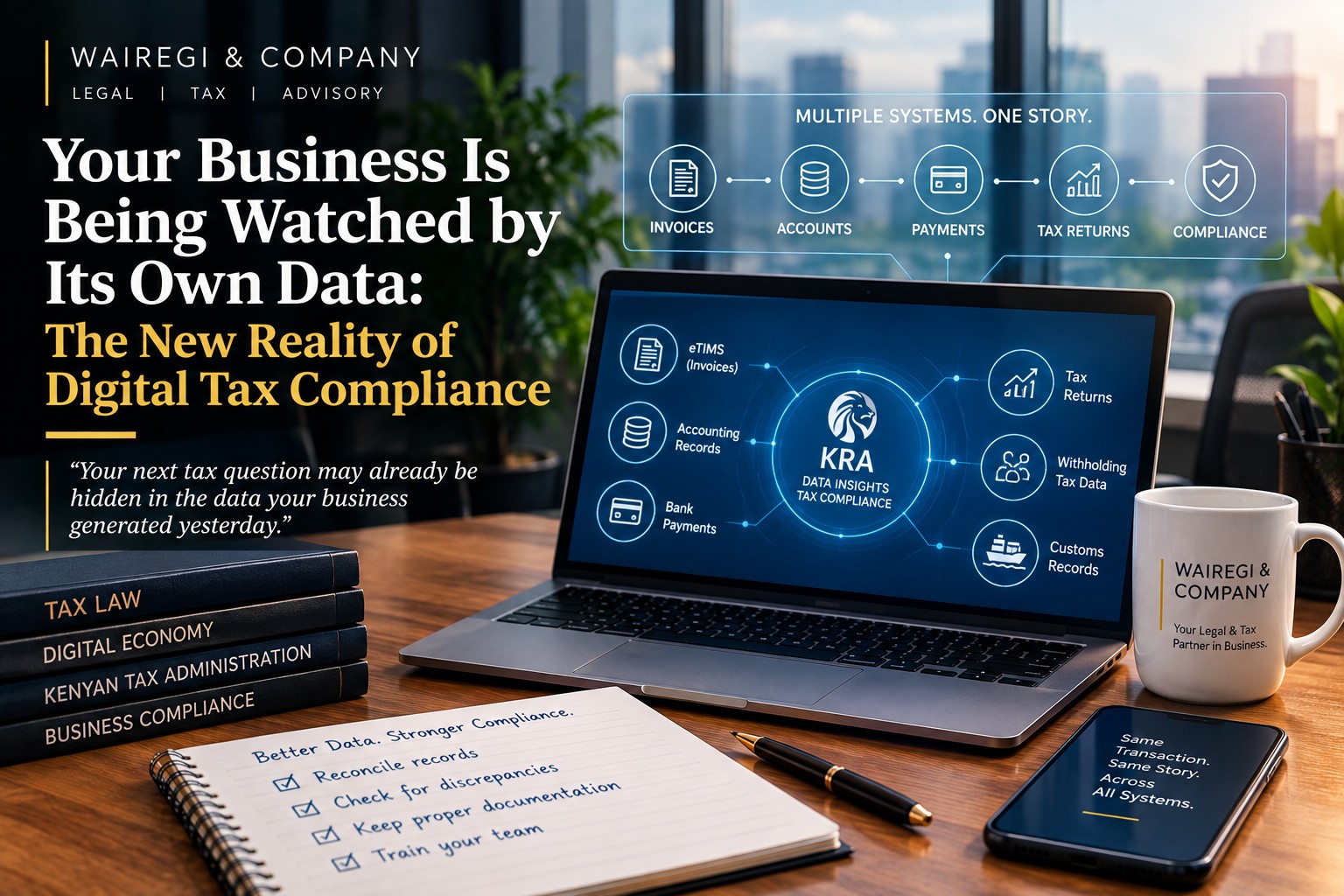
“Your next tax question may already be hidden in the data your business generated yesterday.”
A business may not think of itself as being “watched”.
But every day, it generates information.
Invoices are issued. Payments are made. Purchases are recorded. Imports enter the country. Employees are paid. Tax returns are filed. Increasingly, these activities leave digital records that can be compared against one another.
This is changing the nature of tax compliance in Kenya.
The question is no longer simply whether a business has filed its return. It is whether the story told by that return is consistent with the digital trail created by the business itself.
Your data is telling the story.
Consider a simple sale.
A business issues an electronic invoice. The transaction enters its accounting system. The customer records the purchase. Payment is eventually made and the transaction may appear in the business's tax return.
Each individual record may appear ordinary.
Together, however, they create a picture of the transaction.
KRA's current validation framework demonstrates this direction. From 1 January 2026, KRA began validating income and expenses declared in income tax returns against information including TIMS/eTIMS records, withholding income tax data and Customs import records.
The significance is not simply that KRA has more information.
It is that different pieces of information can increasingly be compared.
When different systems start talking.
Digital tax compliance becomes particularly powerful when systems do not operate in isolation.
eTIMS, for example, can integrate with a taxpayer's existing invoicing or ERP system through system-to-system solutions. KRA's integration framework allows businesses with suitable systems to connect their invoicing processes directly with eTIMS.
This means that information generated in the ordinary course of business can increasingly become part of the tax administration environment without waiting for the taxpayer to manually reproduce it in a return.
For businesses, this creates a new compliance reality.
The accounting system is no longer merely telling management what happened.
It may also help tell the tax authority what happened.
A discrepancy is not automatically wrongdoing.
This does not mean that every difference between two records is evidence of tax evasion.
Businesses have legitimate reasons for differences to occur. Invoices can be cancelled. Credit notes can be issued. Transactions can be corrected. Timing differences can arise. Technical problems can affect electronic transmission.
What matters is whether the business can explain the difference and support that explanation with proper records.
That is why digital compliance should not be approached with fear.
It should be approached with preparedness.
The new compliance habit.
Businesses should increasingly ask themselves a simple question:
If someone compared our major financial records today, would they tell the same story?
That question should extend beyond the tax department.
Sales teams need to capture accurate customer information. Finance teams need to reconcile invoices and payments. Procurement teams need to maintain proper supplier documentation. Management needs to understand where significant discrepancies may arise.
Good tax compliance is therefore becoming a company-wide responsibility.
Data can work for the taxpayer too.
There is another side to the story.
The same data that can expose inconsistencies can also help a compliant business demonstrate that its records are accurate.
A well-maintained digital trail can make it easier to trace transactions, identify errors, reconcile accounts and respond to tax queries.
In other words, digitalisation is not necessarily the enemy of the taxpayer.
Good data can become evidence of good compliance.
The real risk lies in having systems that generate large amounts of information without the business understanding or reconciling that information.
What should businesses do?
Businesses should periodically review the consistency of their accounting records, eTIMS data and tax returns.
They should also maintain proper supporting documents and establish procedures for dealing with cancelled invoices, credit notes, corrections and system errors.
Where accounting or invoicing systems are integrated with eTIMS, businesses should ensure that the integration is functioning properly and that staff understand how information flows between the systems.
The objective is simple: know what your data says before someone else asks you to explain it.
The new reality.
Kenya's tax environment is becoming increasingly data-driven.
The important change is not simply that KRA has introduced more digital systems. It is that the information generated by businesses can increasingly be connected, compared and used to understand the tax position of a taxpayer.
For businesses, this calls for a different mindset.
Tax compliance should no longer be treated as an annual exercise carried out when returns are due.
It is becoming a continuous process of keeping the business's financial story accurate at every stage.
Your invoices tell a story.
Your accounts tell a story.
Your tax returns tell a story.
“In the digital tax era, the safest business is one whose data tells the same story everywhere”.