Loading
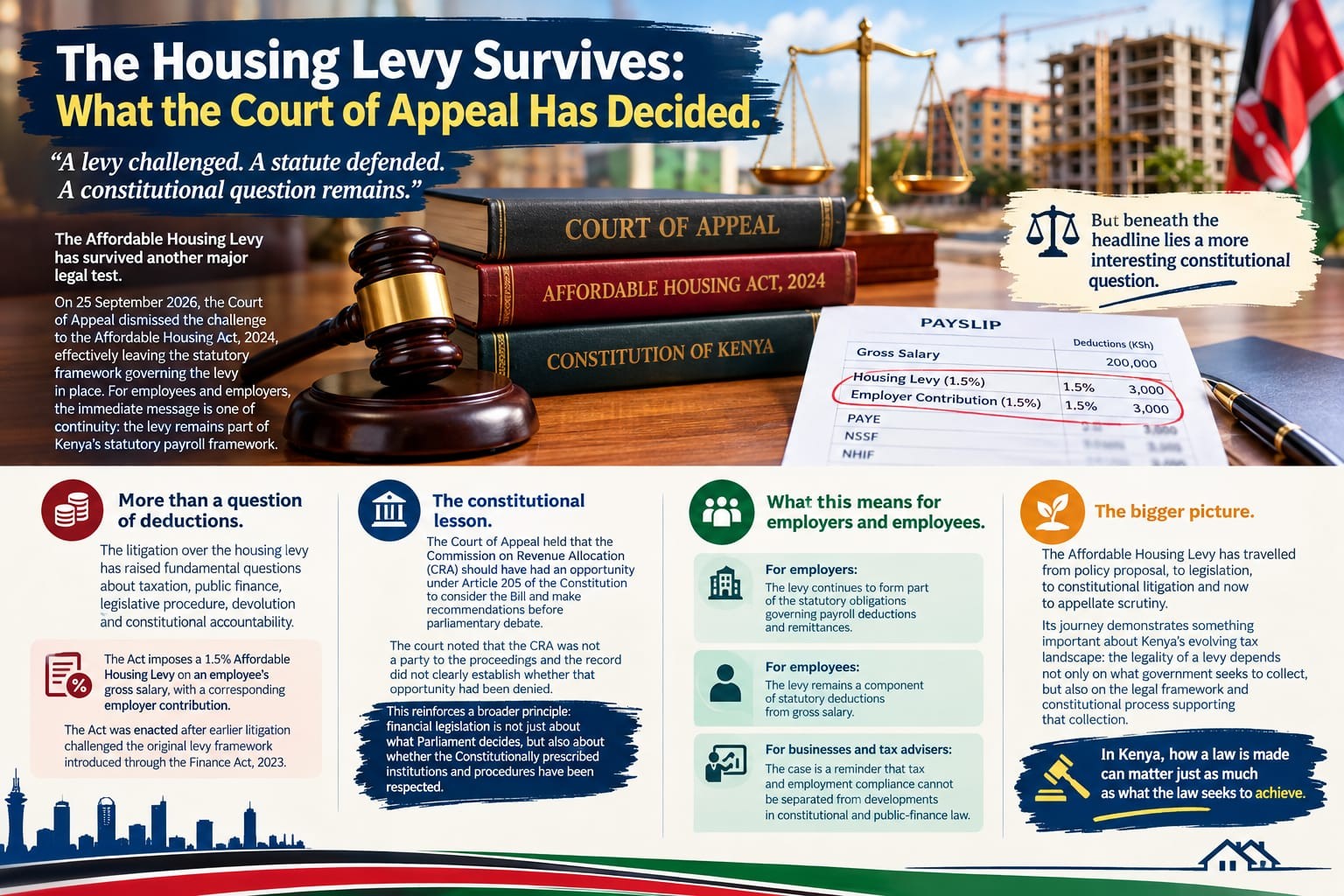
The Affordable Housing Levy has survived another major legal test.
On 25 September 2026, the Court of Appeal dismissed the consolidated appeals challenging the constitutionality of the Affordable Housing Act, 2024, thereby upholding the High Court’s decision sustaining the Act, effectively leaving the statutory framework governing the Affordable Housing Levy in place. For employees and employers, the immediate message is one of continuity: the levy remains part of Kenya's statutory payroll framework.
But beneath the headline lies a more interesting constitutional question.
More than a question of deductions.
The litigation over the housing levy has never been simply about the amount appearing on an employee's pay slip. It has raised fundamental questions about taxation, public finance, legislative procedure, devolution and constitutional accountability.
The current Act imposes an Affordable Housing Levy of 1.5% of an employee's gross salary, with a corresponding employer contribution. The Act was enacted after earlier litigation challenged the original housing levy framework introduced through the Finance Act, 2023.
The Court of Appeal has now upheld the newer statutory framework.
But the judgment leaves an important lesson.
One of the notable issues in the judgment concerns the Commission on Revenue Allocation (CRA).
The Court of Appeal held that, because the legislation makes provision affecting financial matters involving county governments, the CRA should have had an opportunity under Article 205 of the Constitution to consider the Bill and make recommendations before parliamentary debate.
However, the court noted that the CRA was not a party to the proceedings and the record did not clearly establish whether that opportunity had actually been denied.
That observation is significant beyond the housing levy itself.
It reinforces a broader constitutional principle: financial legislation is not simply about what Parliament decides, but also about whether the constitutionally prescribed institutions and procedures have been respected along the way.
What does this mean for employers and employees?
For employers, the practical position remains clear: the Affordable Housing Levy continues to form part of the statutory obligations governing payroll deductions and remittances.
For employees, the judgment means that the levy remains a component of statutory deductions from gross salary.
For businesses and tax advisers, however, the case offers a broader reminder: tax and employment compliance cannot be separated from developments in constitutional and public-finance law.
The bigger picture.
The Affordable Housing Levy has travelled from policy proposal, to legislation, to constitutional litigation and now to appellate scrutiny.
Its journey demonstrates something important about Kenya's evolving tax landscape: the legality of a levy depends not only on what government seeks to collect, but also on the legal framework and constitutional process supporting that collection.
The Court of Appeal's decision therefore closes one chapter of the housing levy litigation while leaving behind a valuable lesson for future financial legislation:
In Kenya, how a law is made can matter just as much as what the law seeks to achieve.