Loading
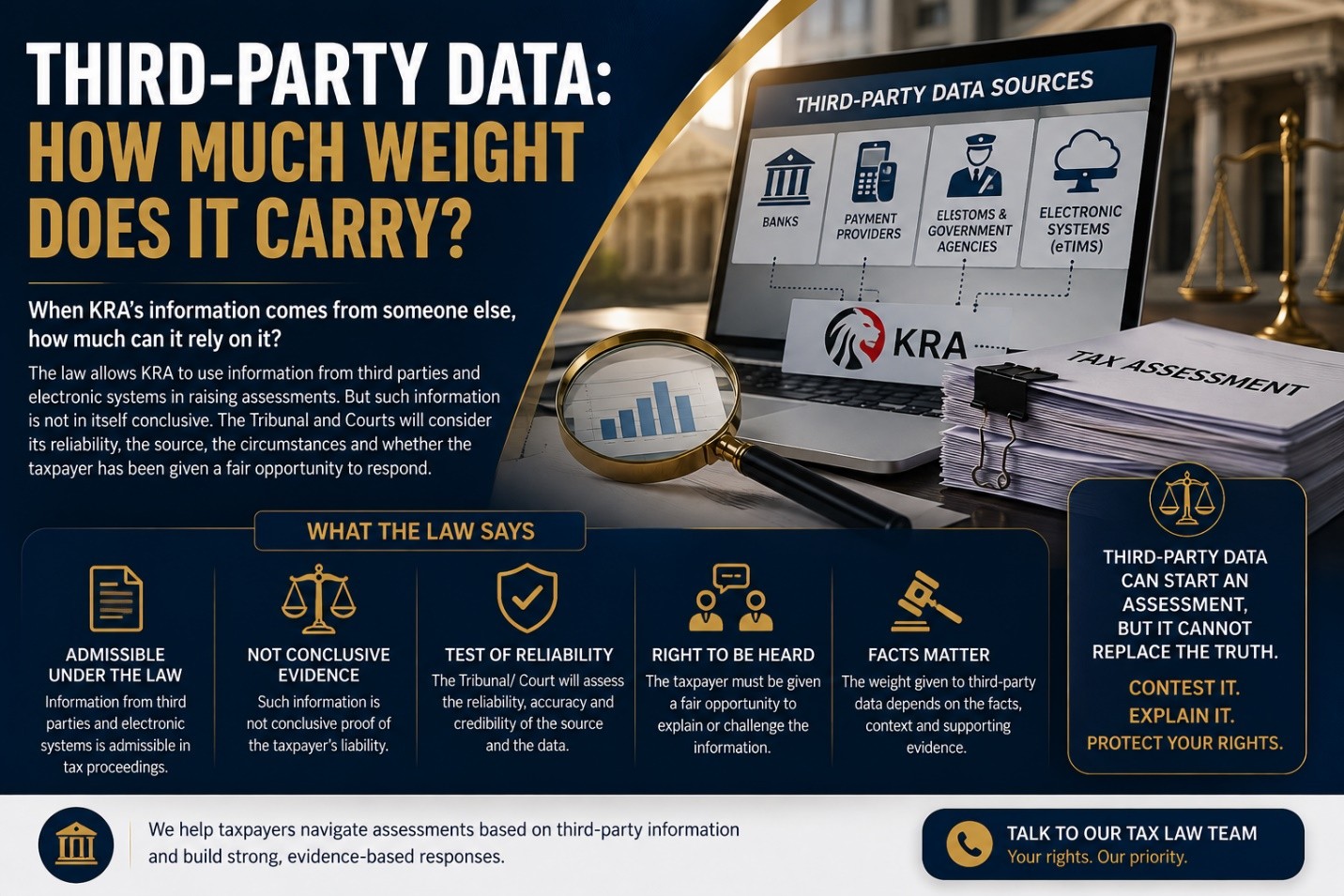
Kenya's tax system is moving from one based largely on taxpayer declarations to one increasingly driven by data.
The Finance Act, 2026 has significantly strengthened this approach. KRA may now rely on a wider range of information when determining a taxpayer's liability, including eTIMS data, third-party returns, withholding-tax and PAYE declarations, inspection findings, whistleblower information and information submitted under other written laws. The law also provides for pre-populated tax returns based on information already available to KRA.
The practical question
Your declaration → Third-party information → KRA comparison → Discrepancy → Assessment
Consider a simple example.
A taxpayer declares sales of KSh 10 million. KRA obtains information from a bank suggesting that KSh 15 million passed through the taxpayer's account.
Does KRA simply tax the additional KSh 5 million? Not necessarily.
A bank statement establishes the movement of money. It does not, by itself, necessarily establish the nature or tax character of every deposit. The additional funds could represent loans, transfers, refunds, capital injections, agency receipts or other non-income transactions.
This distinction was central in Avery Lounge Limited v Commissioner of Domestic Taxes [2026] KEHC 769 (KLR). The High Court recognised that a bank statement records the movement of funds, but does not by itself establish the nature of those funds. At the same time, the Court stressed that the taxpayer must produce the underlying records capable of explaining the deposits.
How much weight does third-party information carry?
Its weight depends on what the information actually establishes and whether the taxpayer can provide credible evidence explaining or contradicting it. The taxpayer's records therefore matter.
Invoices, contracts, ledgers, bank reconciliations, loan agreements, agency agreements and other contemporaneous documents can demonstrate why information obtained by KRA does not represent taxable income or the liability alleged.
The Tribunal illustrated this in Konchor Kid Limited v Commissioner of Domestic Taxes [2026] KETAT 4 (KLR). After the taxpayer produced general ledgers, receipts, bank statements, audited accounts, banking analyses and agency agreements, the Tribunal found that the evidence was sufficient to show that not all bank deposits constituted income. The evidential burden then shifted back to KRA to justify its position.
The taxpayer's right to challenge
The expansion of KRA's information-gathering powers does not remove the taxpayer's right to challenge an assessment.
Under section 51 of the Tax Procedures Act, a taxpayer may object to an assessment within the statutory framework. If the dispute remains unresolved, the taxpayer may appeal to the Tax Appeals Tribunal and, where applicable, to the High Court.
However, section 56 of the Tax Procedures Act places the burden on the taxpayer to prove that the tax decision is incorrect.
This creates an important balance:
KRA may rely on information beyond the taxpayer's return but the taxpayer must produce credible evidence when challenging the resulting assessment.
The courts have recognised that the burden is not necessarily static. In Avery Lounge vs Commissioner od Domestic Taxes, the High Court observed that credible evidence from the taxpayer can displace the presumption supporting the Commissioner's assessment.
The real issue: what does the data prove?
The growing use of third-party information makes this question increasingly important.
KRA may possess the data. But possession of data and proof of a tax liability are not always the same thing.
Where information from a bank, supplier, customer or electronic system conflicts with a taxpayer's declaration, the taxpayer should examine:
· Where did the information come from?
· What transaction does it actually represent?
· Has it been correctly attributed?
· What do the taxpayer's underlying records show?
· Does the information prove taxable income or merely movement of funds?
The takeaway.
The Finance Act, 2026 has given KRA a broader data landscape from which to test taxpayer declarations.
For businesses, this means that a tax dispute may increasingly be decided by reconciling two datasets KRA's information and the taxpayer's records.
A discrepancy may trigger scrutiny.
But a discrepancy is not necessarily a tax liability.
What matters is whether the information relied upon by KRA actually establishes the liability — and whether the taxpayer has the evidence necessary to challenge it.
In the new data-driven tax environment, the strongest position is not simply to say that KRA's information is wrong. It is to demonstrate, with evidence, what the information actually represents.