Loading
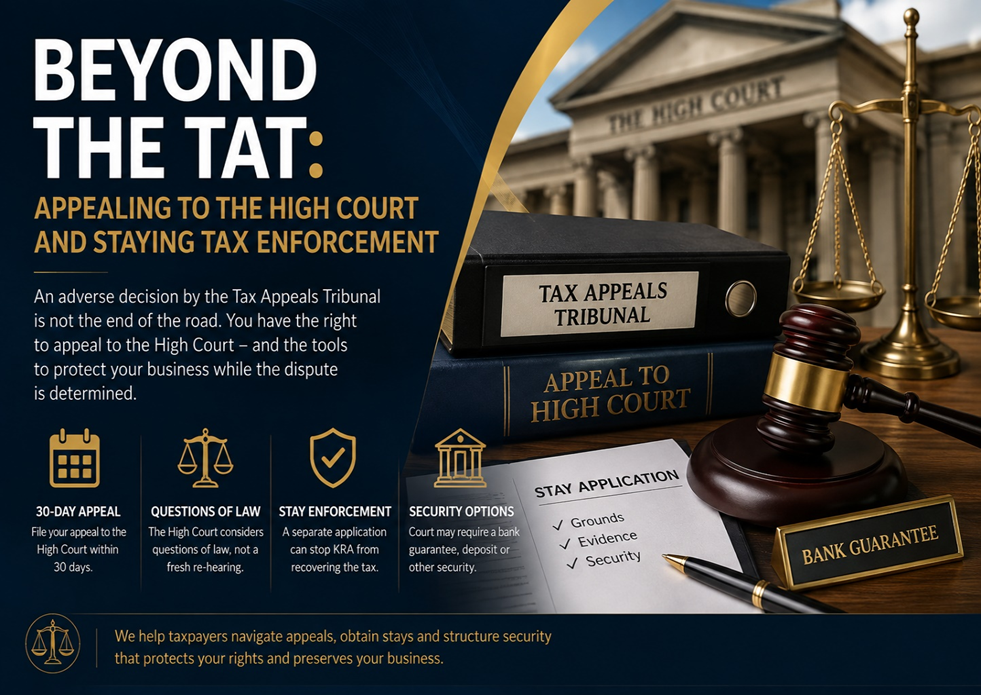
An unfavourable decision by the Tax Appeals Tribunal (TAT) does not necessarily bring a tax dispute to an end. A taxpayer who believes that the Tribunal has erred may take the matter to the High Court. However, the transition from the Tribunal to the High Court involves strict timelines, limits on the scope of the appeal and, importantly, the question of whether KRA can continue enforcing the disputed tax while the appeal is pending.
The 30-day window.
Under section 32 of the Tax Appeals Tribunal Act, a party dissatisfied with a Tribunal decision may appeal to the High Court within 30 days of being notified of the decision, subject to the Court's power to extend time.
This makes the period immediately following a TAT decision critical. A taxpayer should promptly review the judgment, identify the legal issues arising from it and determine whether an appeal is available.
The High Court is not simply a second TAT. The appeal is generally confined to questions of law. The taxpayer must therefore demonstrate an error in the Tribunal's interpretation or application of the law rather than merely asking the Court to reconsider factual findings.
The consequences of missing the statutory timeline can be serious. In Kagame Autospares v Commissioner of Domestic Taxes [2026] KEHC 4160 (KLR), the High Court struck out an appeal filed outside the prescribed period.
Does filing the appeal stop KRA?
Not automatically.
This is perhaps the most important practical distinction for a taxpayer.
An appeal challenges the legal correctness of the TAT decision. A stay of execution or enforcement seeks to prevent KRA from enforcing the decision while the appeal is being determined.
The taxpayer may therefore need to approach the High Court separately for a stay where enforcement is imminent or would cause serious prejudice.
The Court will consider the circumstances of the case, including whether the application has been brought without unreasonable delay, the consequences of allowing enforcement to proceed, and the security available to protect KRA.
In Flippah General Stores (K) Limited v Commissioner of Domestic Taxes [2026] KEHC 1564 (KLR), the High Court considered enforcement measures affecting the taxpayer's bank accounts and granted relief while addressing the need to secure the disputed tax.
Why security becomes important.
A stay is frequently granted on conditions.
The reason is one of balance. The taxpayer wants to preserve its position and continue pursuing its appeal, while KRA has a legitimate interest in ensuring that the tax can be recovered if the taxpayer ultimately loses.
The Court may therefore require the taxpayer to provide security.
This could take the form of a cash deposit, payment of part of the disputed amount, a bank guarantee, or another arrangement considered appropriate in the circumstances.
There is no single formula that applies to every case. The Court has discretion to determine appropriate conditions based on the facts before it.
Bank guarantee or cash?
For a business, the distinction can be significant.
Paying the disputed tax immediately may tie up funds required for ordinary operations. A bank guarantee, where accepted and commercially available, may instead provide KRA with security while allowing the taxpayer to retain its working capital pending the appeal.
Recent decisions illustrate the different approaches courts may take.
In Commissioner of Customs and Border Control v Pesapal Limited [2026] KEHC 1199 (KLR), the High Court granted a stay subject to the provision of a KSh 4,960,751 bank guarantee from a reputable bank within 60 days.
In Asvin v Commissioner of Domestic Taxes [2025] KEHC 2825 (KLR), the Court provided an alternative involving payment of 50% of the disputed tax or a bank guarantee for the entire amount.
These decisions demonstrate that security is not necessarily a fixed percentage imposed in every appeal. The Court considers what is appropriate to protect both parties.
The taxpayer must show why a stay is necessary.
A taxpayer seeking a stay should be prepared to demonstrate the consequences of allowing enforcement to continue.
Where a business argues that immediate recovery would disrupt its operations or cause substantial financial prejudice, the claim should be supported by evidence rather than general assertions.
At the same time, the Court will consider KRA's interest in protecting public revenue.
The result is a balancing exercise:
Taxpayer's right to pursue an appeal ↔ KRA's interest in securing public revenue
Security is often the mechanism through which that balance is achieved.
Where does the finance act, 2026 fit in?
The Finance Act, 2026 has significantly changed Kenya's broader tax administration and enforcement environment, particularly through the increased use of electronic and third-party information.
There has also been considerable discussion around proposals relating to the conditions under which taxpayers may pursue tax appeals. However, it is important to distinguish proposals made during the legislative process from the provisions ultimately enacted.
The existing appellate framework remains: a TAT decision may be challenged before the High Court within the statutory period, with the appeal generally confined to questions of law. Security ordinarily becomes a question when the taxpayer seeks a stay of enforcement, and the Court determines the appropriate conditions.
What should a taxpayer do after losing at the TAT?
The period immediately after the Tribunal's decision should therefore be treated as critical.
Review the decision → Identify questions of law → Observe the 30-day period → Assess enforcement risk → Apply for stay where necessary → Address security → Proceed with the appeal.
A taxpayer should not wait until KRA has commenced recovery before considering these steps.
Conclusion.
An adverse TAT decision is not necessarily the end of the road. But an appeal is not simply a matter of filing papers and waiting for a hearing.
The taxpayer must simultaneously consider the appeal, the risk of enforcement and the security required for a stay.
For businesses facing substantial tax demands, a properly structured stay — including the possibility of a bank guarantee — may help preserve cash flow while the High Court determines whether the Tribunal got the law right.